

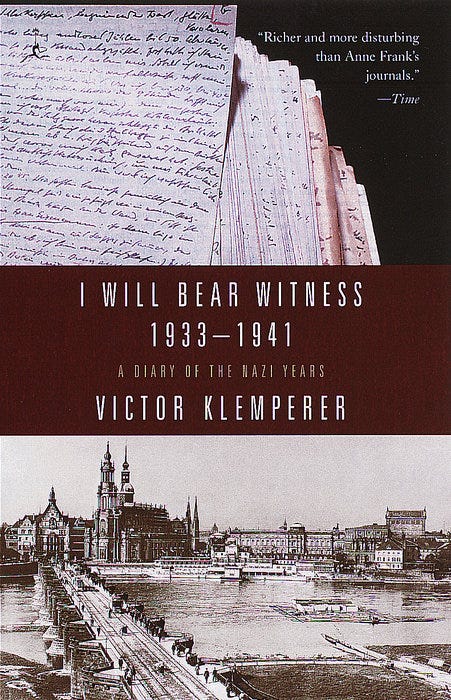
From time to time, I’d like to share with you where Hitler was at in a comparable moment to this time in Trump’s second term of office. We can do this via a unique set of diaries written by Victor Klemperer, called I Will Bear Witness: A Diary of the Nazi Years.
Usually, when people compare Trump to Hitler, they’re just sending a general message that Trump is authoritarian, but it’s interesting to read an ordinary person’s take on what was happening in the moment, at a time in Germany when they did not know what we now know about the horrors that were yet to take place.
Klemperer lived half his life in Dresden, Germany, moving there in 1920 at the age of 39, to take a post as professor at the Technical University, where he taught French literature and philology, the study of the use of language. His passion for philology inspired him to note down objectively in his diary all the ways the Nazis used and abused language in their speeches, orders, and propaganda.
He had gone to school in fits and starts, apprenticed to a trade, studied and lived in France, specializing in the writings of the French Enlightenment, especially Voltaire and Montesquieu. The French writings of that period were viewed as “superficial” by Germans of Klemperer’s time, so his respect for and interest in French ideas of skepticism and political liberty set him apart from many of his German colleagues.
For a time, Klemperer was a literary journalist, though he came to doubt his ability to make a living as a writer, and later went back to school for a doctorate in order to establish a career as a professor. In 1912, while a journalist, he gave a talk in Berlin, and was introduced as “a young combative literary man who writes with rare courage and is not afraid to speak out against established authorities.”
His father was a rabbi who, after a clash with his local Orthodox congregation, moved the family to Berlin and became a Reform rabbi. That’s the style of Judaism that uses no Hebrew, no skullcaps, and no food restrictions.
Victor’s older brothers ended up converting to Protestantism, which in Germany cleared the way for them to become prominent in society, two in medicine and one in law. Victor stayed in academia, and married an accomplished pianist and musicologist. Her Protestant family questioned her marrying a Jew, while his family questioned his marrying a musician.
It was said that Klemperer was an advocate of women’s rights and that he and Eva were a good team throughout their lives together.
Although Victor eventually converted to Protestantism, the Nazis registered him as Jewish. For most of World War II, he was saved from the concentrations camps by his marriage to a Christian, plus privileges and honors earned when he fought for several months in 1915-16 for the Germans in World War I. (After four months at the western front, a serious illness put him in the hospital and discharged him from the army.)
Things changed after Kristallnacht 1938, the major Nazi pogrom which was followed by laws banning Jews from using cars, libraries, cinemas, swimming pools, parks, telephones, radios, typewriters, or tobacco, having pets, buying flowers, and restricting their food rations. In 1940, the Klemperers were forced to move into a designated Jews’ House, and in 1941 Victor, as a registered Jew, had to wear a yellow Jewish star. He hated to go out of the house with that star on his chest and be subjected to demeaning abuse or pity.
But he and Eva managed to survive in Dresden until February 13, 1945. That morning, the order went out that all 198 registered Jews left in Dresden had to report for deportation to the camps on the 16th. That same night, however, American and British planes dropped explosive and incendiary bombs, destroying 1600 acres of the city center and killing over 20,000 people. In the confusion, Klemperer ripped off his Jewish star, and escaped with Eva, blending into the flood of refugees. Fearful of being recognized and reported, they kept on the run for three months until they ended up in a city occupied by American soldiers.
All the while, he had maintained his diary, noting down personal and political events as they happened. Not long after Hitler took power, Klemperer documented the quick disintegration of laws and the silencing of opposition, as well as a quiet certainty among many that the regime could not last very long. Trump has attempted the same actions but for the most part our courts are holding; the Department of Justice is losing 95% of its cases. And independent media like Substack and some magazines and TV shows are speaking their mind, whether through reporting or comedy.
Hitler took power on January 30, 1933; Trump on January 20, 2025. As I write this, we are one year and three months into Trump’s second term. At that point in Hitler’s reign, April/May of 1934, the spring semester of Klemperer’s university was getting started, but only a handful of the usual hundreds of students showed up. In his diary, Klemperer suggested two reasons for this: one was that the Labor Service put college-age students to work for several months, and many hadn’t returned in time. The other reason was simply that “university study in general was being throttled.” The Nazis, he wrote, “do not want anyone to study; intellect, scholarship are the enemies” (italics are original).
Students were also being commandeered to help with a new “Campaign against Fault Finders and Grumblers.” Goebbels announced this campaign in a “rabble-rousing” speech on May 11, along with a “last warning to the Jews” that a pogrom would come down on them if they didn’t stop the international boycott against German goods. This boycott was a response by the international community against Hitler’s violence and harrassment against Jews.
Klemperer noted a desperation behind the speech, because the boycott was having an effect. Housing and highway projects were faltering, and Goebbels told foreign listeners that the Germans couldn’t pay their debts, pointing out that the current government didn’t make any agreements to pay in the first place; it was their predecessors’ fault. He blamed the Jews for the boycott, but promised them no harm “if they remain quietly in their homes” and do not claim to be of “full or equal value.”
Not only did many citizens believe the Hitler government was unstable and unlikely to last, but many members of the Nazi party found ways to believe that things weren’t as bad as they seemed. For example, in April 1934, the Klemperers went to see a man who could help them with financing for a house they were building in the suburban area of Dresden. The man was a Nazi party member but blamed all Nazi troubles on middle managers of the party — “all around he sees mismanagement, ill-feeling, catastrophe can no longer be far away. He condemned the lack of proportion of the anti-Semitism, he maintained that only the subordinate leaders were still using it for incitement, at the top they were already trying to calm things down.”
People were hopeful things would get back to normal soon, but the war was four years away, and the regime held on until losing the war seven years later.
Klemperer’s diaries are fascinating. By replacing “Jews” with “immigrants” we can’t avoid seeing parallels to today. I’ll share more down the road.
Thanks for this. A reminder of why there is an attack on academia. Looking too closely at history may work harder to avoid the repetition.