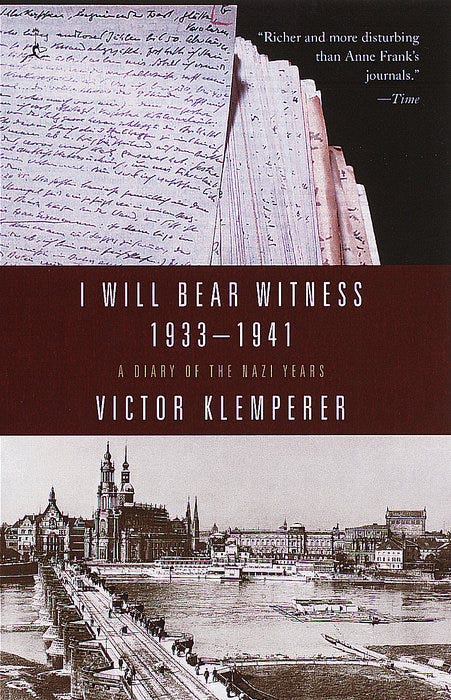
A couple of months ago, I discussed Victor Klemperer's I Will Bear Witness: a Diary of the Nazi Years, comparing his contemporaneous observations of the beginning of the Nazi regime with our current situation at the start of a Maga administration. Klemperer lived in Dresden, Germany throughout the Nazi era, until Dresden was firebombed, allowing Victor and his wife Eva to escape — just two days before he was scheduled to be sent to a concentration camp.
A professor and philologist (studying the use of language), Klemperer was a keen observer of the Nazi regime, its propaganda, and its impact on his students, friends and neighbors.
In the last post, I quoted diary entries from about one year and three months into Hitler's regime. I was writing one year and three months into Trump's regime, and wondered about average German experiences before any knowledge of World War 2.
Now, two months after my last post on this subject, we are one year and five months into Trump's regime. At the comparable time for Klemperer, in June/July of 1934, he writes "we see everything from the point of view and the heart's desire of Hitler's downfall."
Two of his students at the time were Catholics who were strongly anti-Nazi, and said that they could not bear to repeat the required catechism that they "believe in Hitler". Meantime, another classmate was an SA member who insisted “plaintively” that “I am not a soldier.” This was true -- the SA stormtroopers were not a part of the army. They were Hitler's stormtroopers, untrained thugs dressed in brown shirts and ordered to support Hitler's policies, with violence if necessary — a group which finds an echo in Trump's ICE troopers.
Klemperer writes of Germans finding their way around various decrees. For example, people from one town were not allowed to buy from a local Jewish shop so they went to a second nearby town to buy from that town’s Jewish shop, while residents of the second town traveled back to the first town for the same reason. He writes that it was a “tacit convention” that if you’re visiting the Jewish shop in the other town, and happen to "run into someone from [your] town, no one has seen anyone else."
Confusion and contradiction was fostered by the Nazis among the people. Klemperer comments about one man who, "out of a certain contrariness and a childish pleasure in dispassionate objectivity...sympathizes somewhat with Hitler. After all he has achieved a great deal for the nation as a whole" though the man counters that Hitler is a "demon" regarding his racial ideology and then equivocates that "the Jews are not blameless."
Another acquaintance has a son in the stormtroopers, and says "I do not see much of my children anymore... I have to be careful talking in front of them; mistrust has been sown in the heart of the family."
A fellow professor speaks of his daily struggle with having to give a Nazi salute. He does it and can bring himself to say "Heil" but not “Hitler." According to him, people in southern Germany people preferred to say "God bless" when they could get away with it, and when he assembled 40 people to listen to a Nazi festival on the radio, only 5 stayed to hear Hitler's speech.
Some friends and relatives of Klemperer’s were in the process of leaving Germany after just over a year of the Nazi regime. A few cousins left for England and the U.S. One couple left for Uruguay. (I know someone who recently left the U.S. for Uruguay because of Trump's anti-trans rhetoric and policies.)
Several of his Jewish friends traveled to Palestine, hoping to establish a home there, though the British wouldn't allow them to stay unless they were farmers, artisans, or had significant assets. At this point, Klemperer rails against the colonizing fever of Zionists. It's important to note that “Zionist,” before the Holocaust, referred to certain aggressive political activists who had a colonial attitude towards having a Jewish homeland. This turned many Jews anti-Zionist, though not anti-Holy Land. The fact is that many Jewish families were not exactly “colonists”— they had lived in that land for thousands of years, many staying on even after the ancient Romans sought to expel them in the 2d century and renamed Judea “Syria-Palestina” as a deliberate insult. So “Zionist,” as discussed in Klemperer’s diary, meant something quite different from today's meaning, which, based on Palestinian talking points, now usually refers to any Jew who lives in Israel. But lots of Jews were and are anti-Zionist in the sense of being anti-colonial. In the early 1900s, for example, the Jewish Bund in eastern Europe was the largest political activist group supporting revolution against the Russian Czar, with the goal of ending violent, recurring persecution of Jewish communities. The Bund strongly opposed Zionism and advocated that Jews fight for civil rights in the places where they lived. The Bund ended up being stealthily co-opted by Lenin before the revolution; its members were later virtually eliminated by Stalin and Hitler.
One of Klemperer’s friends claimed to oppose antisemitism, while advocating positions which were in fact antisemitic. After discussing several such puzzling people, Klemperer muses in his diary that "perhaps Eva and I took the world too seriously. One has to see the funny side of things. Because the majority of people are so thick-skinned that they are not really touched by disgrace of the spirit."
Political events at the time included a new decree by the Education Minister requiring all teachers to get an annual four-week "national political overhaul," and Klemperer notes the "mechanistic" language, treating people like machines or cars needing a tuneup.
Early that summer, due to economic troubles, the Nazi regime laid off many workers, and the SA (stormtroopers) were put on temporary leave. But the chief of the SA, Ernst Röhm, portrayed this leave as an intentional strategic move, saying that "we wish to grant our enemies the brief hope that we shall not come again. But on August 1 we will be back again in full force and do what is necessary." This sounds eerily similar to the way “border czar” Tom Homan backed off on ICE operations due to major pushback but then threatened that "We're coming to New York City in a way you've never seen before."
That period in mid-1934 was a key moment for Hitler’s authoritarianism. SA chief Röhm wanted the stormtroopers incorporated into the army but the army resisted, being formally under the control of President von Hindenburg. Unexpectedly, Hitler ordered the execution of his former friend, Ernst Röhm, and six of his “accomplices,” who were painted as conspirators to a mutiny. Klemperer wrote "The confusion in the populace's ideas is shocking. A very calm and easygoing mailman...who is not at all [Nazi], said to me...'Well, he simply sentenced them.'" In fact, Hitler didn't sentence but simply executed members of his own private army without any hearing or trial, and a few weeks later, once first impressions had settled, Hitler boasted that there had actually been "77 put against the wall," while foreign reports suggested that the number killed was more like 500. This came to be known as the "Night of the Long Knives." When the German President died a month later, Hitler took over his job as well, gaining authority over the military. This allowed for a full rearmament of Germany, and led to ever greater authoritarian control of the country.
Interestingly, after hearing the beginning of Hitler's speech on the subject, Klemperer comments in his diary that Hitler sounded like a fanatical preacher. “The man is lost and feels it; for the first time he is speaking without hope. He does not think he is a murderer. In fact he presumably did act in self defense... but after all he appointed these people to their posts, and after all, he is the author of this absolutist system."
Klemperer goes on to write, "The dreadful thing is that a European nation has delivered itself up to such a gang of lunatics and criminals and still puts up with them."